

20 January 2026: New OPTOMICS publication out in Cardiovascular Diabetology!
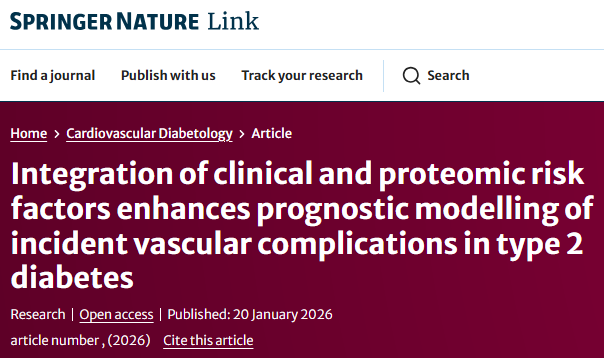
Our newest paper, published in the journal Cardiovascular Diabetology, titled “Integration of clinical and proteomic risk factors enhances prognostic modelling of incident vascular complications in type 2 diabetes,” addresses a central challenge in diabetes care: predicting who will develop vascular complications before irreversible damage occurs. Using large‑scale plasma proteomics alongside established clinical risk factors, we identify protein signatures that improve long‑term prediction of both macrovascular and microvascular complications in individuals with type 2 diabetes. By analysing nearly 3,000 circulating proteins and more than a decade of follow‑up data, we show that integrating proteomic information substantially enhances prognostic performance beyond clinical variables alone, with stable predictive value over time for macrovascular outcomes.
In the context of OPTOMICS‑driven research, this study provides an essential molecular layer to complement high‑resolution optical assessment of diabetes‑related vascular dysfunction. Many of the prognostic protein markers identified reflect biological processes—such as endothelial stress, inflammation, and vascular remodelling—that are also measurable through advanced optical imaging of microcirculation and tissue structure. By linking circulating proteomic signatures with optical phenotypes, this work strengthens the foundation for integrated, multimodal risk modelling. Such an approach supports earlier and more precise stratification of individuals with type 2 diabetes and advances OPTOMICS toward a comprehensive, mechanistically informed strategy for predicting and preventing vascular complications.
You can read the full article here: https://doi.org/10.1186/s12933-026-03083-6